website is up! Mostly finished with a few pages to fill in.
Things to do:
- Set up blogging
- Fill in the links page

Things to do:
- Set up blogging
- Fill in the links page
Intro
Philosophy
Methodologies
Anatomy of a Coord
Putting it Together: LORElita Examples
Futher Reading and Resources
.jpg)
The question of Modesty
Modesty continues to be a much debated subject in Lolita fashion. Wearing JSK's without a blouse, showing shoulders or bare legs, and other questions of modesty continue to crop up with heated discourse. There are some Lolita adherents who believe that modesty is a central tenant in Lolita fashion, and others who do not believe it to matter at all. What of LORElita? Well, the answer here is both yes and no. No, LORElita is not a fashion in which modesty is a central moral concern. However, it is based on fashions in which modesty was. Medieval, Renaissance, Regency, even Victorian and Rococo, all had their own ideas of modesty and propriety, and so LORElita outfits will reflect these aesthetics in various ways. That is to say, you don't have to worry too much about the morality of modesty in how you put a LORElita coord together, but in concentrating on historical construction, which is a tenant of LORElita, the coord is likely to read as modest to modern day people simply because it is based on clothes from eras in which people dressed more modestly.
LORElita as a Lifestyle
Now, far be it from me to try to police how someone lives or what hobbies they have, so take this with a grain of salt. You don't need any of the following to wear LORElita, but the idea of LORElita as a “lifestyle” is interesting just as much as Lolita as a “lifestyle”. When we think of Lolita fashion, it brings to mind visions of pretty girls at tea parties, strolling through rose gardens, and doing delicate feminine activities like embroidery. LORElita is by contrast a bit more of a “tomboy” fashion. A lifestyle LORElita might be a swordfighter or an archer in their free time, might like video games and SCA clubs. It is an embracing of geeky pursuits and physicality. Reading, studying history, cooking historical foods are all LORElita coded activities as well.
Of course, just as you don't need to be a delicate and gentle girl who does feminine things to wear Lolita, you also don't need to be a rough and tumble fencer, or a total nerd for Lord of the Rings to wear LORElita. But these are just some of the things that I personally like and feel have great synergy with my fashion!
Music Scene?
In my research on alt fashion scenes, it appears that they are often very deeply tied, at least in their beginnings, to a music scene. Lolita is no exception, and has a rich history of being tied to the music of Japanese bands such as Malice Mizer. LORElita by contrast, does not have that tie. Instead, I would say that my primary source of that same kind of spirit of wistful yearning for art comes from literature. You could say that my Mana Sama is JRR Tolkien!
Historical Construction Inspirations
While Lolita sticks to the roots of Rococo (1730-1780) and Victorian (1830-1900) fashions, in LORElita we branch out to any other era you may be interested in exploring. The Medieval period is a wide span of time, ranging from roughly 500-1500, the Tudor period spans about 1480-1600, Renaissance period about 1300-1600. Within these are of course all sorts of little pockets of fashion trends, also dependent on all sorts of factors like area and social status.
And so, the methodology of the construction of a LORElita outfit begins with choosing a particular time and place to draw inspiration from and then researching what sort of clothes would be worn and what sorts of silhouettes would be in fashion.
DIY Focus
While Lolita has a fairly heavy consumerism aspect, LORElita is, somewhat by necessity, a very DIY focused style. There are not really many brands making what I think fits as “LORElita” (though there are a few!), which was of course part of what drove me to making my own dresses since the precise things I wanted did not seem to exist! DIY and thrifting are a prime focus for LORElita, which isn't to say that everything in your coord needs to be handmade as this is a guideline more than an actual rule, but rather that one should approach LORElita as an avenue of self expression and creation as much as possible, rather than it being about consumerism.
Silhouette
The most prominent place that LORElita does not deviate from Lolita is in the silhouette- in fact, it may be the strictest part of the conceptualization of what makes something LORElita and not just Renfaire garb! This is the shape of the skirt, and the silhouette that this gives. Whether you're doing a gathered skirt, a pleated skirt, a gusseted skirt, it should be made big and full enough to be worn with a nice poofy bell shaped or flared petticoat (or crinoline, or farthingale, as you like, depending on how historically accurate you want to get) and should be knee length or thereabouts.
Art Motifs
So the construction methodology of LORElita is historically based, but what about the printed artwork? Well, in keeping with the 'lore' in LORElita, I conceptualized this style as being primarily inspired by history, literature, and pop culture. At the time of writing this I have made an Animorphs inspired dress, am working on ideas for a Lord of the Rings print and have plans to do some Pokemon ones as well. More broadly however it can also be about anything geeky or nerdy. If trains are your passion, a train print would be perfectly acceptable, or a math and physics print! Really, the sky is the limit here, but try to think outside of the box. While the 'kawaii' of Lolita isn't bad, the focus should be more on 'nerd' than on 'cute'.
Layer 1: Undergarments
Undershirt (Chemise, blouse, smock, ect)*, Underwear (Panties or bloomers) Socks or stockings
Layer 2: Structure Garments
Skirt structure (Farthingale, petticoat, crinoline ect), Upper body structure (girdles, stays, corsets ect)
Layer 3: Dress
Skirt, bliaut, dirndl, JSK, ect.
Layer 4: Overgarments
Cardigan, cloak, apron, ect.
Layer 5: Outerwear
jackets, coats, cloaks, hats and shoes ect.
 Medieval LORElita
“Luthien”
Luthien is an elven princess and heroine from Tolkien's The Silmarillion. A magical and otherworldly being, she represents a medieval and chivalric ideal of femininity and grace, but she also represents strength of will and personal agency as she braves all manner of danger, monsters, Dark Lords, and the afterlife to rescue and aid her love.
This dress is based on the gothic kirtle, sometimes today called a cotehardie or simply a cote as there is some confusion on the proper terminology for this garment. Simple in construction, this would historically be worn over top of a basic smock, (a plain white T-Shirt will give you this vibe) and would provide the support that in modern times we get from a bra. It could either be worn as is, or with a more fanciful gown over top like a bliaut or a houppelande.
I have to this design added a medieval belt or “girdle” as they were called then, and matching trim which brings more of the aesthetics of the bliaut to the garment.
 Renaissance LORElita
“Dulcinea”
In Don Quixote by Miguel de Cervantes, Dulcinea is the ideal woman as envisioned by the main character, a fantasy of nobility and feminine perfection. In reality, the Dulcinea of Don Quioxte's imagination is a peasant woman named Aldonza, hardy and practical. While the fantasy of Dulcinea is shown to be a fiction, I believe there is beauty in this duality. The image of both noblewoman and peasant, of femininity and agency, of a womanhood ideal within the working lady.
This dress is actually a stays and skirt set. A typical Lolita skirt and petticoat is here paired with a set of Renaissance era long stays, which would be worn over a chemise, or what we would in modern days call a “peasant blouse”.
Stays, like the kirtle, could be worn as outerwear, or worn under a fancier gown. Tudor style dresses and mantuas are great places to look for inspiration, but I personally like the more peasant look of the stays themselves.
 Victorian LORElita
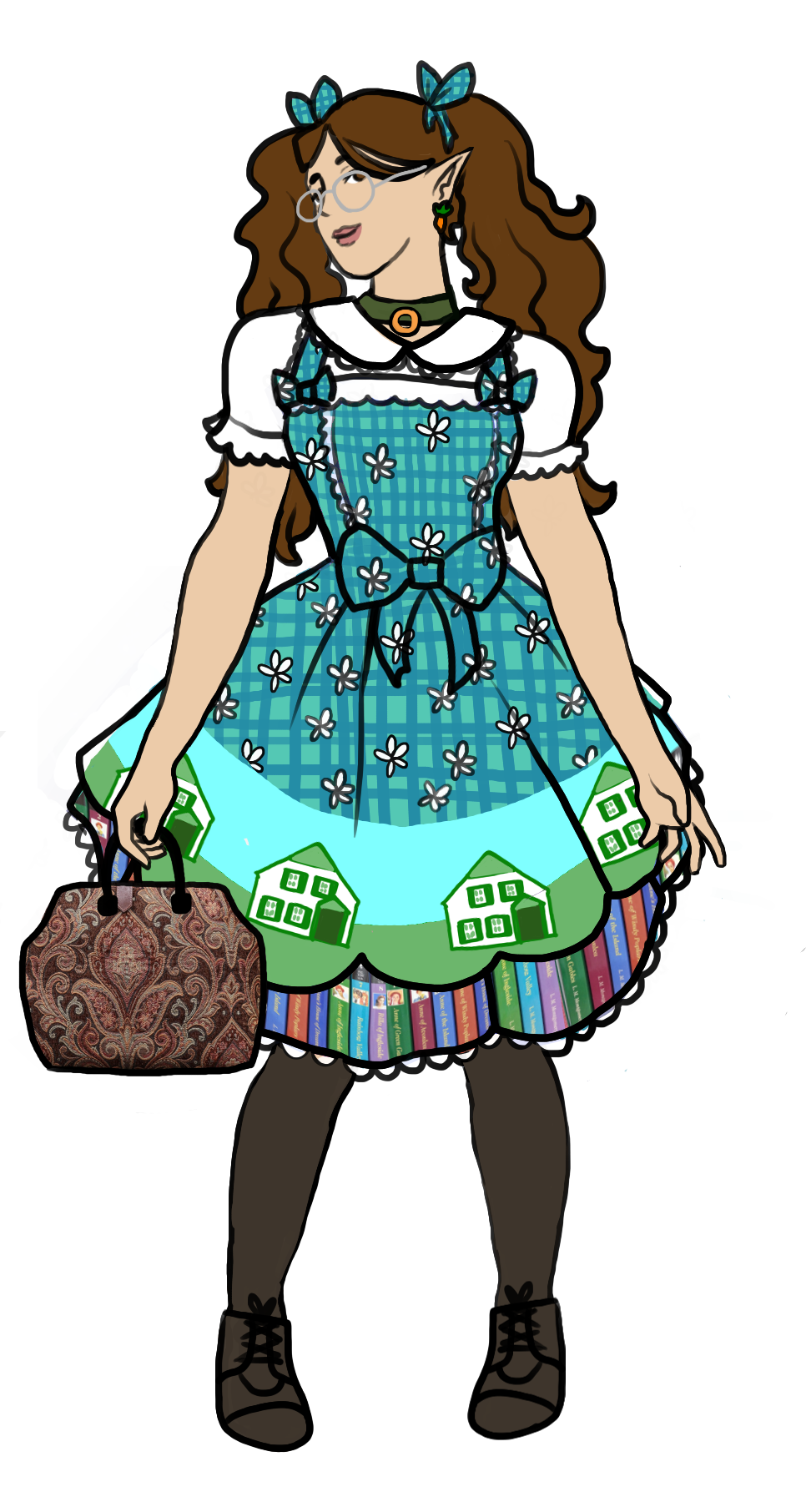
“Anne”
While the obvious literary inspiration for clothes from this era might be Alice of Alice in Wonderland fame, enough people have cited Alice in relation to Lolita already, and I thought it time to give another Victorian girl a turn in the spotlight, and so I chose for my inspiration Anne of Anne of Green Gables. She's nerdier anyways, an inspiration and delight to weird little head in the clouds girls everywhere. Anne is a dreamer and a scatterbrain, and the perfect choice for a nerd inspired fashion tradition.
This is the dress style I like to make that is the most on brand for Lolita and deviates from form the least. I have here a Lolita style JSK paired with a Peter Pan collar blouse. The important factor here is the prints, which should be extravagantly nerdy, this one of course featuring the motif of the classic Green Gables.
If you want to go a little more Rococo than Victorian, many Lolita OPs take their inspiration from the Robe a la Francaise or the Robe a la Anglaise, and those are great options for historical inspiration as well!
If you want to go for a Rococo shape and silhouette to your frame, I recommend wearing stays underneath this as your shaping garment, or for a Victorian shape, a corset.
 Contemporary LORElita
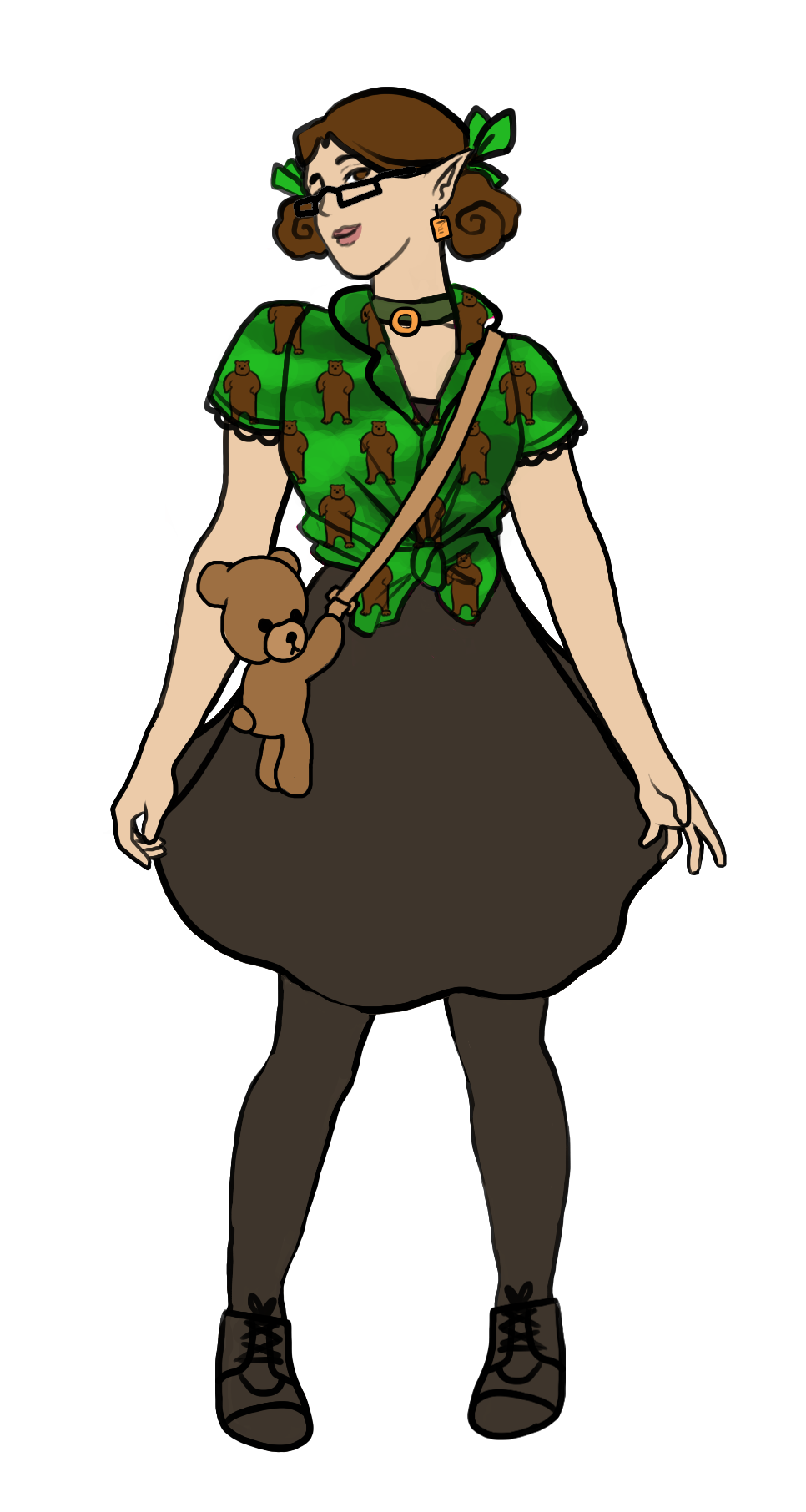
“Rachel”
When looking to contemporary clothing for inspiration, we come to the greatest deviation from Lolita form in my personal style catalog. I have named this one for Rachel from Animorphs, a girl who is both stylish and girly, as well as an aggressive and courageous warrior. She is the channel for one's inner Joan of Arc, or Xena: Warrior Princess.
While Animorphs is from the 90's, for this look to nod in the direction of Lolita we have to commit a cardinal 90's fashion sin: tucking in the top. Either use a T-shirt with a nerdy graphic tucked into a high waisted skirt, or use a men's all over print or Hawaiian style button down, tied in the front. The top should be baggy on you, as the idea is to create a shape here, flairing out on the top, cinching in at the waistline, and then flairing out again in the skirt, which can be a little bit shorter than knee length for this style. A skater dress works really well rather than a skirt too!
To make this nod a bit more towards Lolita, you can embellish a shirt with detailing like lace on the edges, make the collar rounded to give more of a Peter Pan collar vibe, or even use scalloped edges.
Unfortunately modern clothing doesn't tend to work with stays, but try wearing a modern bra over an undershirt for more comfort!
These are all of course, just my own designs and suggestions! Maybe you are more inspired by ancient Greco-Roman clothing, and want to design a toga based LORElita! Maybe your inspiration is primarily ancient China! The beautiful thing about LORElita is that is is about researching history and re-creating it with your own unique spin. This book is not an end all be all final say on what LORElita is, but rather my blueprints for a philosophy to approach creating my own unique clothing style, and I hope that it may inspire you to do the same.
Shaping Femininity
Corsets and Codpieces
So Pretty / Very Rotten
Gothic Fashion: The History
Brands
Haenuli
A Lolita brand that consistently has absolutely amazing prints that reflect the ideas of LORElita, like their Joan of Arc dress or their Little Prince dress. I have their Jellyfish print dress and I love it!
Duchess Milianda
Another Lolita brand that's doing some really cool prints on their dresses that totally fit with LORElita! I would love to get their Unicorn Tapestries print dress some day.
Damsel in this Dress
Damsel is a corset maker, and their quality is out of this world!! Their corsets are made with upholstery fabric and steel boning, and I've had one of their corsets last for well over a decade. They have several lovely designs, and tend to use really fun flamboyant fabrics.
Holy Clothing
Renfaire garb, with some absolutely beautiful kirtle and bliaut style dresses!
Lorelita
I would be remiss if I did not mention that there IS an upcycling fashion brand called Lorelita. Their work is lovely and I love their sustainability policies! However, they are not in any way related to Lolita or historical fashions, so I include them here only as an acknowledgment, to avoid confusion.